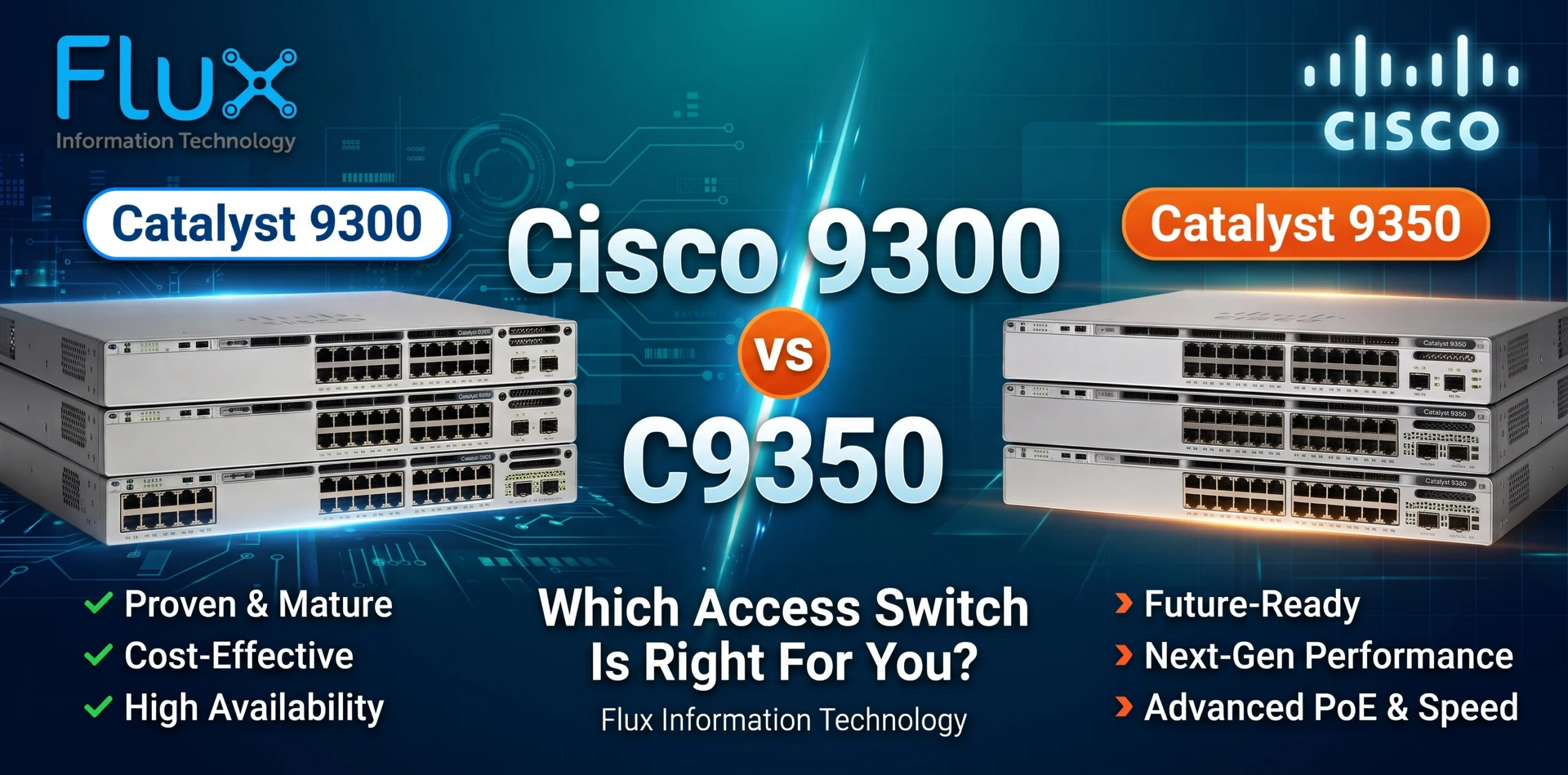
When Cisco introduces a new switch family, the IT world pays attention. With the arrival of the Cisco Catalyst C9350, network architects and procurement teams are asking a familiar question: Should we jump to the new C9350 or stick with the tried-and-true Catalyst 9300?
Here at Flux IT Hardware, we help businesses navigate these exact upgrade dilemmas every day. Based on recent industry analysis, here is a breakdown of the differences between the new C9350 and the previous C9300 model and how to decide which platform belongs in your access closets.
The Reigning Champion: Cisco Catalyst 9300
The Catalyst 9300 shouldn’t be viewed simply as the “older” model. Instead, it is the proven, mainstream enterprise access platform. It is mature, reliable, and represents a lower-risk enterprise access solution.
For the vast majority of standard office deployments featuring standard collaboration endpoints, wired clients, and standard Wi-Fi coverage, the 9300 is more than sufficient. It offers an established ordering motion, widespread availability, and a lower total cost of ownership (TCO). If your priority is maturity, price, and proven project fit, the 9300 usually wins.
The Next-Gen Edge: Cisco C9350
The C9350 isn’t just a basic spec bump; it is a higher-end, future-facing smart switch platform built around Cisco’s Silicon One architecture. It is designed for environments that are actively pushing the boundaries of edge performance, power delivery, and automation.
The C9350 brings clear technical advantages in several key areas:
- Higher-End Multigig Access: The C9350 is built for heavy bandwidth, offering support for up to 10 Gbps multigigabit Ethernet on downlinks and up to 100G uplinks.
- Massive PoE Headroom: As edge devices like Wi-Fi 6E/7 access points, AI cameras, and USB-C powered displays demand more juice, the C9350 delivers with published support for up to 90W PoE (UPOE+).
- Expanded Stacking Scale: While the 9300 is famous for its 8-switch StackWise-480 framing, Cisco’s public C9350 collateral touts support for up to 16-switch stacking. For designs where stack scale is a critical factor, this is a major technical differentiator.
- Advanced Edge Processing: With higher base memory, a faster CPU, and NVMe storage, the C9350 moves deep inspection and containerised app hosting closer to the edge.
| Feature Focus | Cisco Catalyst 9300 | Cisco Catalyst C9350 |
|---|---|---|
| Best Commercial Fit | Mainstream enterprise access projects | Edge environments requiring high power/bandwidth |
| Multigigabit Support | Standard 1G/2.5G/5G capabilities | Strong messaging up to 10 Gbps downlinks |
| Uplink Capacity | Flexible uplink architecture by model | Supports up to 100G uplinks |
| PoE Delivery | Standard PoE+ and UPOE options | Heavy density 90W UPOE+ delivery |
| Stacking Limit | Up to 8 switches per stack | Up to 16 switches per stack |
Which Should You Choose?
The real decision isn’t whether the 9350 is newer, but whether your project actually benefits from that newness enough to justify the premium.
Choose the Catalyst 9300 if: Your network consists of standard office floors, your PoE requirements are stable, and your budget favours maturity, faster delivery, and a proven track record.
Choose the C9350 if: You are deploying next-generation Wi-Fi access points, need massive 90W PoE power budgets, require 100G uplinks, or have a specific design need for larger stack scale and future-proofed telemetry.
Upgrade Your Network with Flux IT Hardware
Whether you decide to rely on the proven Catalyst 9300 or invest in the future-facing C9350, Flux IT Hardware is here to support your deployment from start to finish.
- Source Your Switches: Ready to procure? Buy new and refurbished Cisco hardware directly from our extensive, ready-to-ship inventory.
- Stretch Your Budget: Looking to offset the cost of a C9350 upgrade? Take advantage of our Trade-in, trade-up program to maximise your IT budget.
- Liquidate Legacy Gear: If you’re clearing out old access closets, don’t let that hardware collect dust. Sell unwanted Cisco equipment to us for quick capital recovery.
Contact the Flux IT Hardware team today to discuss your next Cisco deployment and ensure you get the exact right platform for your network’s unique demands.
Frequently Asked Questions – Catalyst 9300 and C9350 switches
Absolutely. Whether you are looking to purchase the newer C9350 series or need to source reliable, refurbished Catalyst 9300s to expand an existing footprint, our team can help. Don’t forget to utilize our Trade-in, trade-up program to use your old legacy hardware to offset the cost of your upgrades!
Yes. Both the Catalyst 9300 and the new C9350 run on Cisco IOS XE. This means you can seamlessly integrate the new C9350 switches into your existing Cisco Catalyst Center (formerly DNA Center) environment without forcing your network engineers to learn a completely new operating system or CLI.
While multigigabit models of the 9300 can support modern wireless access points, the C9350 is purpose-built for the heavy demands of next-gen wireless. With up to 10 Gbps downlinks and massive 90W UPOE+ power budgets, the C9350 provides the necessary bandwidth and power headroom that Wi-Fi 6E and Wi-Fi 7 access points require.
No. Because they utilise different underlying hardware architectures (the C9350 is built on Cisco’s Silicon One ASIC), you cannot stack Catalyst 9300 and C9350 switches together in the same StackWise ring. If you are adding to an existing 9300 stack, you will need to stick with Catalyst 9300 series switches.
While the C9350 represents the next generation of access switching, the Catalyst 9300 is still a current, fully supported platform. Cisco has not announced End of Sale (EoS) or End of Life (EoL) dates for the core 9300 lineup. It remains a staple in enterprise networking and a highly reliable choice for new and ongoing deployments.